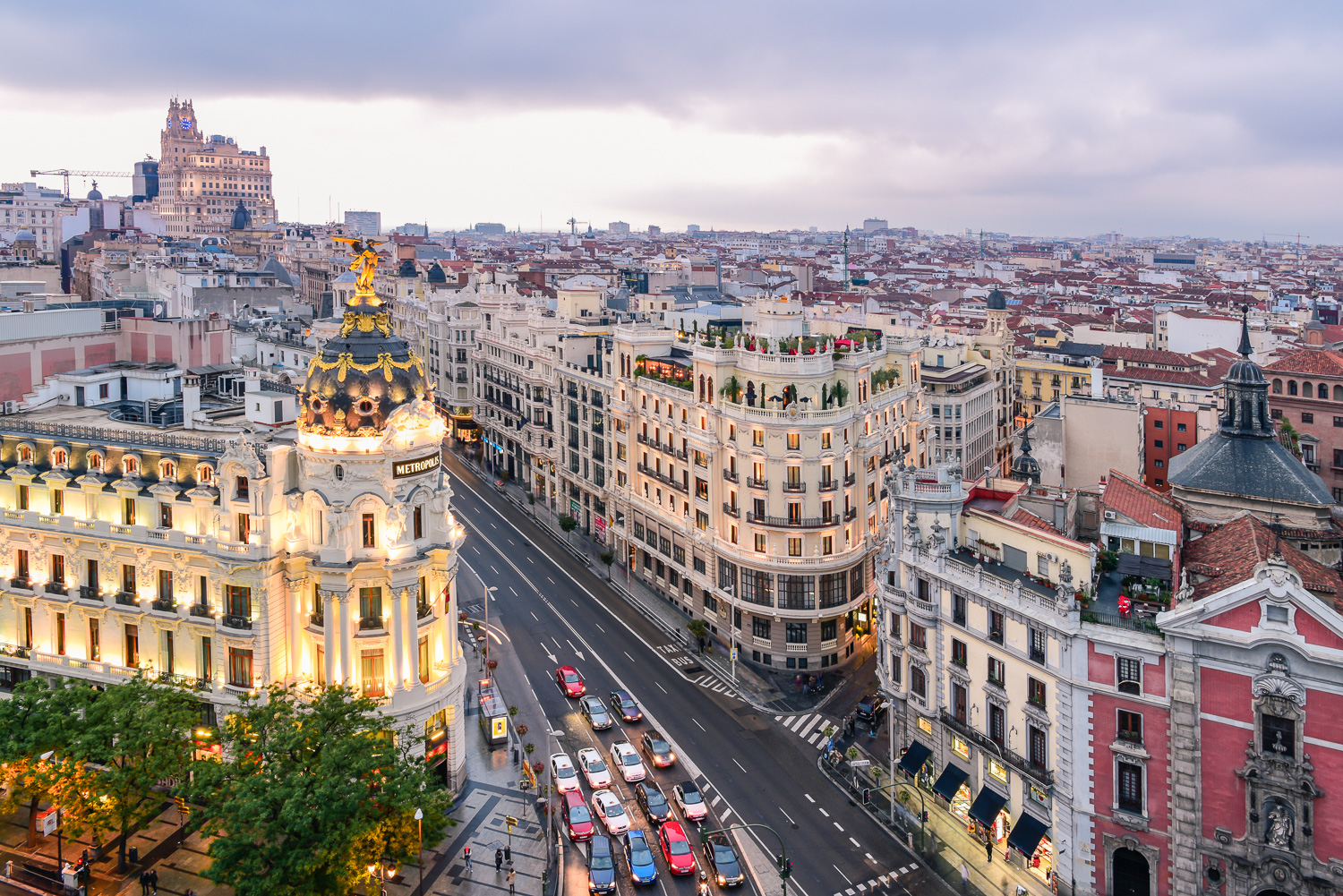
Geography
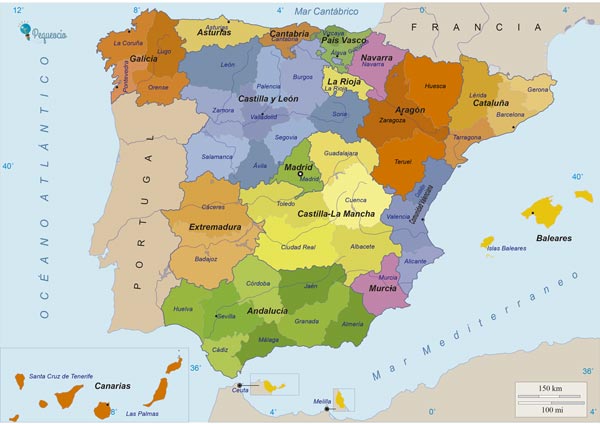
Located in southwestern Europe, Spain occupies approximately 85% of the Iberian Peninsula which consists of Spain, Portugal, Andorra, and Gibraltar (World). Spain covers 505,370km2 in total, and it neighbors Portugal on the west, Andorra and France on the northeast, and Gibraltar to the south as well as Morocco across the Strait of Gibraltar. There are mountains throughout the country in the North, East, and South (World).
Population
Spain’s total population is 48,563,476 with a population density of 97.33/km2 (World). The most populated city is the capital, Madrid, with 3,255,944 inhabitants, followed by Barcelona with 1,621,537. The following most populated cities are Valencia (814,208), Sevilla (703,206), and Zaragoza (674,317) (World).
Demographics & Immigration
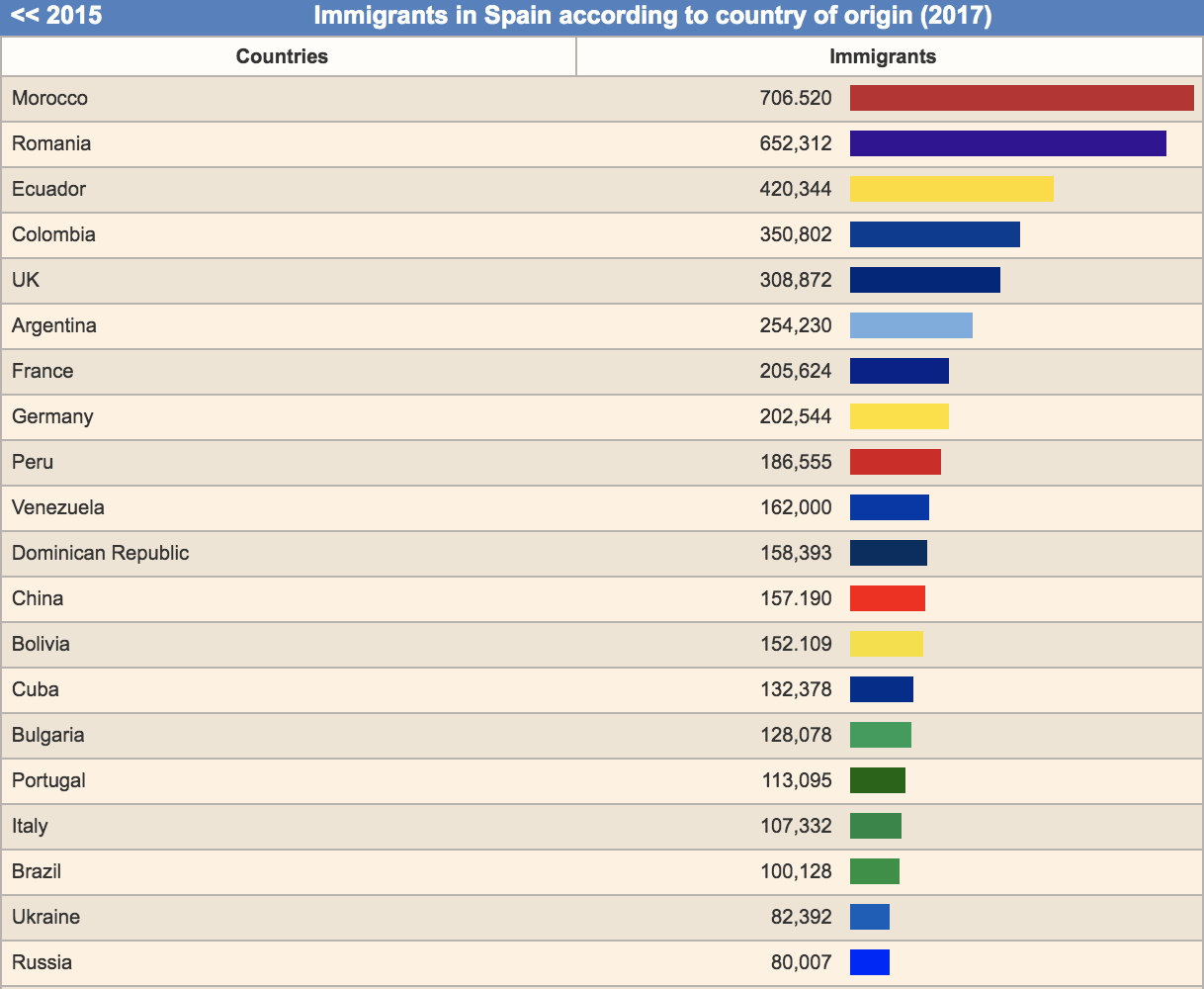
Spain’s population is 50.94% female and 49.06% male, not accounting separately for individuals who identify outside of the gender binary (Spain). Spain is home to 5,947,106 immigrants (last calculated in 2017) from many areas of the world, most commonly neighboring countries like Morocco, Latin American countries, other European countries, and Asian countries. The countries with the largest immigrant populations in Spain are Morocco (706,520), Romania (652,312), and Ecuador (420,344) (España). The World Happiness Report ranks Spain as the 19th most accepting country for immigrants in the world (Helliwell).
Recent History
Several hundreds of years ago, Spain had a complicated history with being inhabited by different religious groups (Christians, Moors, and Jews), being followed by a series of invasions and conflicts. Now, Spain is a Catholic country with many cultural influences from groups that previously inhabited the land, specifically the Moors (Shubert).
In the 1930’s Spain was in a civil war that divided the country into the republicans (Spanish government along with unions, communists, anarchists, workers, and peasants) and the nationalists (the fascists). The republicans were referred to as the “reds,” or “los rojos,” and the nationalists were referred to as the “blues,” or “los azules.” After the civil war, the country was ruled by the fascist dictator Francisco Franco until his death in 1975 (Shubert).
Current Political Situation
After Franco’s death, the country transitioned into a democracy with a constitutional monarchy (World). The country has both a prime minister as well as a king and queen. The current political situation has been turbulent since Mariano Rajoy took office as prime minister in 2011 with him leaving office in 2018 as a result of a motion of no confidence. He was succeeded by Pedro Sánchez temporarily, and Sánchez won the Spanish popular election in April of 2019 (Cué). The time period after Franco’s death created a culture of organized protest in Spain that has been quite prevalent in Spanish culture since that time period. Spaniards highly value their right to free speech as well as to protest against political and social issues.
Spain’s provinces have many stark regional differences, some as blatant as different languages being spoken or unique cultural practices from the rest of Spain. One region that has recently been trying to gain independence as its own country is Cataluña, the region that houses Barcelona. The Catalan people feel a great difference from the rest of Spain due to a different overall lifestyle, as well as the fact that their predominantly spoken language in the region is Catalán, as opposed to Castilian Spanish. The movement of Independentismo has been quite prevalent in the past couple of years causing a lot of protest (some that has even become violent) and political strife between the region and the rest of Spain (Esparza). Many Catalán people who identify as Independentistas do not identify with the Spanish national flag, rather with the flag of the region of Cataluña.
Hofstede’s Cultural Dimensions
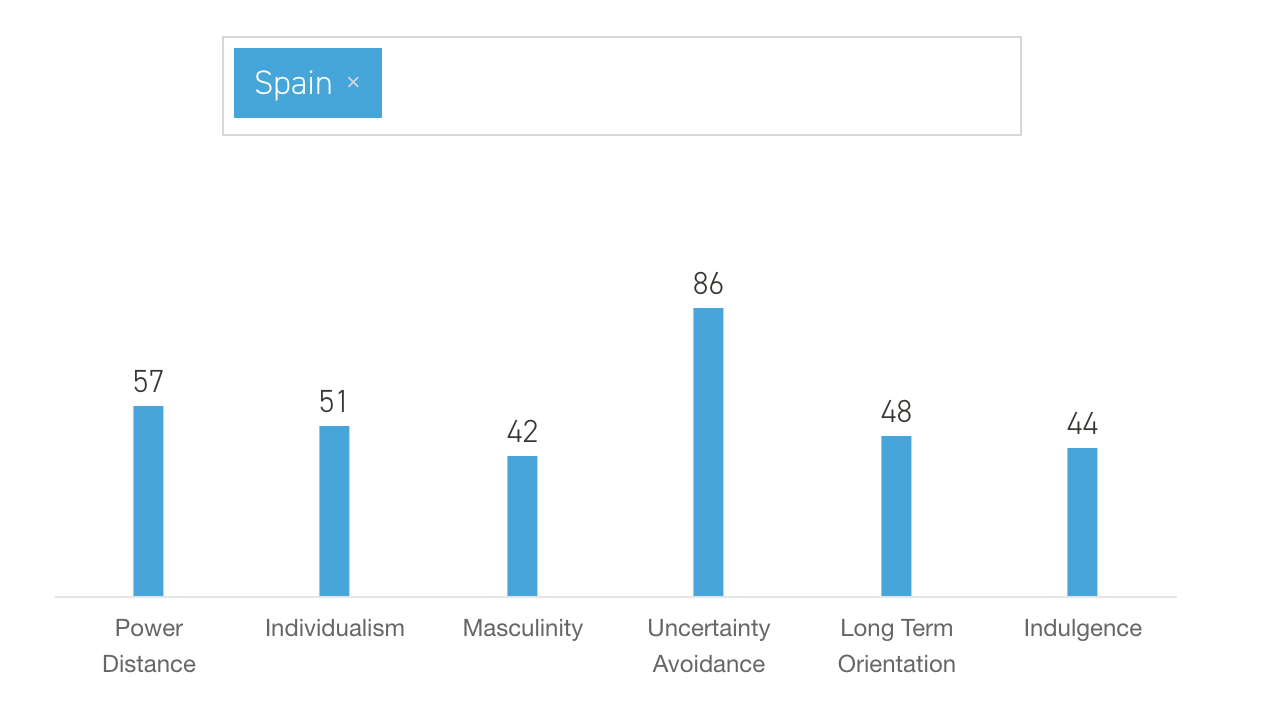
Power Distance: Spain’s score of 57 is relatively high, meaning that it is a hierarchical society. This means that everybody knows their place and there is a respect for hierarchy and superiors (Hofstede).
Individualism: Spain has a middle-range score of 51. It is considered individualistic for the world’s standards, but collectivistic for European standards. Spaniards often do base their self-image heavily on themselves and their immediate family, but teamwork is viewed as something natural and Spaniards value the ability to easily relate to others (Hofstede).
Masculinity: Spain scores at 42, which is considered a middle score in this category. This means that consensus is key. Spaniards don’t like polarization or excessive competition. It is important to like what you do, while there is still a bit of need to be the best. There is often a concern for those in need, and sympathy is a big Spanish value (Hofstede).
Uncertainty Avoidance: Spain has a high uncertainty avoidance with a score of 86. Change creates stress, and often Spaniards are threatened by ambiguous or unknown situations (Hofstede).
Long Term Orientation: Spain has a lower-medium score of 48 in this category. This means that Spaniards, while needing clear rules and structures in place to maintain order and security, like to live in the moment (Hofstede).
Indulgence: Spain has a lower-medium score of 44 in indulgence. This means that actions are sometimes restrained by social norms, and indulgence can sometimes feel wrong. Indulgence is a dimension that is definitely changing in today’s modern Spanish society (Hofstede).
Gender & Feminism

According to the Human Development Reports, Spain ranks #26 in the world in terms of gender equality (Human). In recent years, Spain has had a huge prevalence of feminism in mainstream culture. Spain’s celebration of International Women’s Day (8M) is one of those that yields the most participants in the world in terms of organized feminist march attendance across the country with heavy concentration in large cities. 2019’s March 8th holiday was observed or celebrated by 5.3 million Spaniards (Burgos).
Spanish Lifestyle
Spanish lifestyle is one that can be considered slower in pace. Spaniards enjoy spending leisure time with family and friends chatting over food and drinks, and their everyday routines are very reflective of this (Richardson). Spanish culture is socially informal, meaning that people are more likely to “swing by and say hi,” or prompt a social gathering to occur immediately rather than plan a few days ahead. This goes in line with Hofstede’s finding that Spaniards live in the moment. Perceptions of time are not as rigid in Spain as in other countries, meaning that being late in social situations is not as frowned upon as in countries such as the United States. Siestas, or afternoon naps, are something that Spain is known for. Shops and some businesses shut down during this extended lunch-time, specifically during the hot summers.
Spain is considered a rather healthy country with an average life expectancy of 83.3 years (Human). Access to healthcare is very important to Spaniards, and the country operates under a universal healthcare system. Spain ranks #36 in happiness on the World Happiness Report (Helliwell). Spain is deemed as a country with a high quality of life all-around.
Languages
Castilian Spanish is the official language of Spain, and 90% of the population of Spain speaks it as their first or second language. The other largest regional languages are Catalán from the region of Cataluña (spoken by 17% of the population), Gallego from the region of Galicia (spoken by 7% of the population), and Euskara from the Basque Country region (spoken by 2% of the population) (Commisceo). Many professionals who were in school post-Franquismo speak English.
Cultural Onion
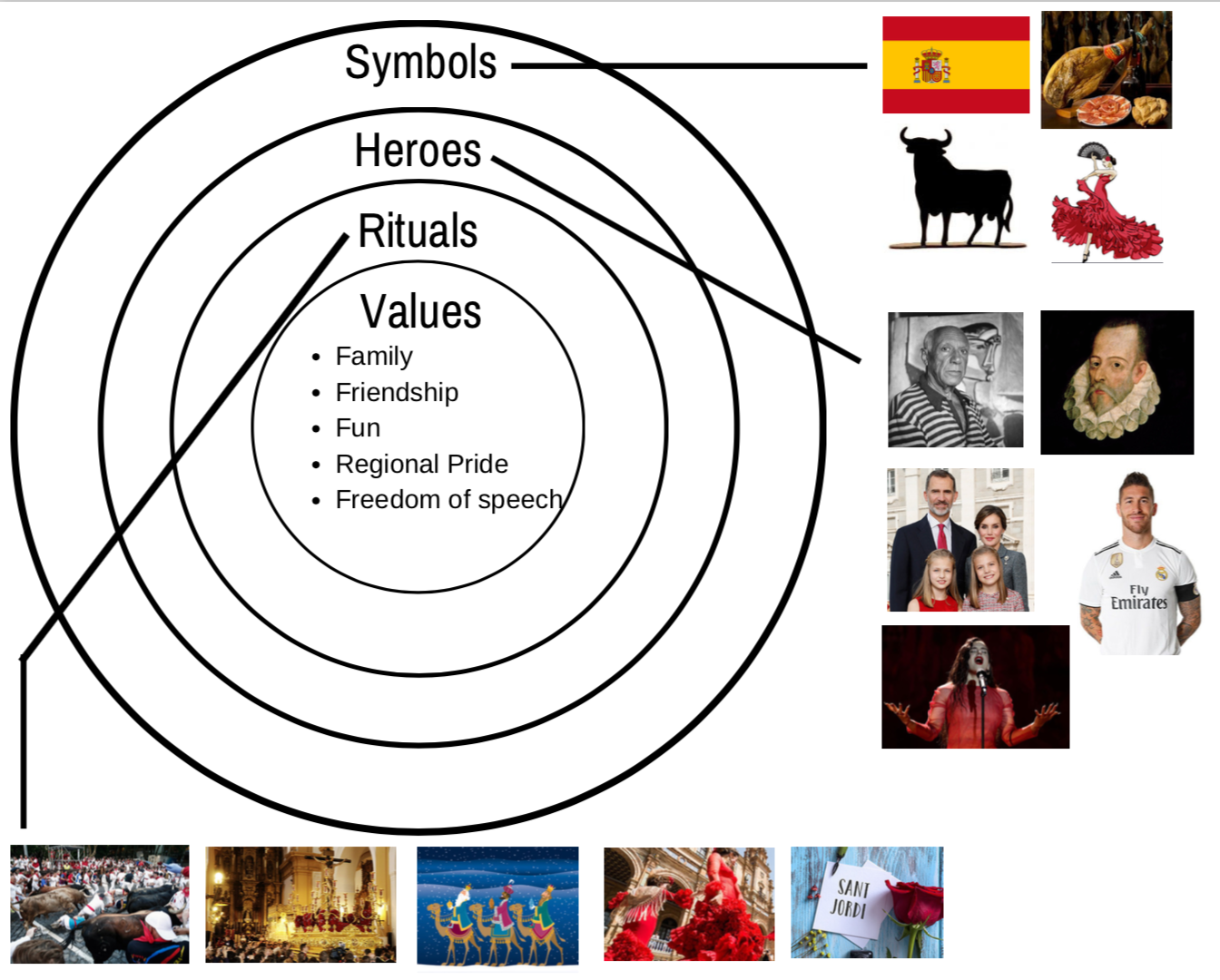
Symbols: Flag of Spain, serrano ham, bull, flamenco dancer.
Heroes: artists and writers, pictured are iconic artist Pablo Picasso (left) and author Miguel Cervantes who wrote the most famous Spanish novel, “Don Quijote,” (right). Monarchy, athletes (specifically soccer players, hence featured Real Madrid player, Sergio Ramos), and celebrities (pictured is modern flamenco singer, Rosalía).
Rituals: running of the bulls (San Fermín), Catholic holidays (specifically Holy Week, or Semana Santa, for Easter), Reyes or the three wise men bringing children presents the eve of January 6th, La Feria De Abril which is the annual flamenco festival in Sevilla, and Sant Jordi in Cataluña which is the day of the book and also the celebration of the region’s patron saint, Jordi.
Values: Family, friendship, fun, regional pride, freedom of speech.
Works Cited
Burgos, S. (2018, March 08). 5.3 million observed morning strike on Women’s Day. Retrieved from https://elpais.com/elpais/2018/03/08/inenglish/1520498047_423763.html
Commisceo Global Spain Guide. (n.d.). Retrieved from https://www.commisceo-global.com/resources/country-guides/spain-guide#c3
Cué, C. E. (2019, April 30). Post-election Spain: Don’t expect governing deals anytime soon. Retrieved from https://elpais.com/elpais/2019/04/30/inenglish/1556608489_985863.html
España – Inmigración 2017. (2018, June 15). Retrieved from https://datosmacro.expansion.com/demografia/migracion/inmigracion/espana
Esparza, P. (2018, October 01). 6 preguntas para entender qué sucede en Cataluña un año después del referendo independentista – BBC News Mundo. Retrieved from https://www.bbc.com/mundo/noticias-internacional-45649240
Helliwell, J. F., Layard, R., & Sachs, J. D. (2018). World Happiness Report. Retrieved from https://s3.amazonaws.com/happiness-report/2018/WHR_web.pdf
Hoefstede, G. (n.d.). Country Comparison. Retrieved from https://www.hofstede-insights.com/country-comparison/spain/
Human Development Reports. (n.d.). Retrieved from http://hdr.undp.org/en/countries/profiles/ESP
Richardson, J. S., & Shubert, A. (2019, March 7). Daily Life and Social Customs Spain. Retrieved from https://www.britannica.com/place/Spain/Daily-life-and-social-customs
Shubert, A., Viguera, M. J., Koenigsberger, H. G., Richardson, J. S., Carr, R., & O’Callaghan, J. F. (2019, March 03). Spain. Retrieved from https://www.britannica.com/place/Spain
Spain Population 2019. (n.d.). Retrieved from http://worldpopulationreview.com/countries/spain-population/
World Atlas Spain Geography. (2018, July 18). Retrieved from https://www.worldatlas.com/webimage/countrys/europe/spain/esland.htm

 Operación Triunfo in Spain
